Chapter 3: Standing, Serving & Keeping Time
Parts One and Two recovered two parts of the same design. The economic system explained how property is conveyed, how an Enterprise Owner is appointed with an Owner’s Draw for self and family, and how residual is kept to build the community’s capital. The spatial and governance system explained the mile-square PLOT, the twenty-four public buildings, the four courts, and the 1,920 seats those courts contain. What remains is the question: for whom were those seats created? A seat is only a place. Someone must enter it, serve for a limited time, leave without being forced out, and be replaced without a contest — and the whole community must keep time in a way that prevents one office from taking over another.
Three key documents guide this part: STAND says that each person holds one office and does not take over another. ROTATE explains how presiding changes hands and how one seat is renewed at a time. CHOSEN explains how an open seat is filled without letting one person or group control the final choice.
The Source Panels
DOC 7: STAND — Recorded 22–23 September 1832, hand of Frederick G. Williams, Kirtland, Ohio.
“Therefore, let every man stand in his own office, and labor in his own calling; and let not the head say unto the feet it hath no need of the feet.”
The keystone text is supported by another in the same register: “let every man learn his duty, and to act in the office in which he is appointed in all diligence … he that is slothful shall not be counted worthy to stand.”
DOC 8: ROTATE — Discourse, 27 February 1835, as reported by Oliver Cowdery, hand of Warren A. Cowdery, Kirtland, Ohio.
The instruction to the newly chosen Twelve: that whenever they assemble they should appoint one of their number to preside over the meeting, and one or more to keep a record of the proceedings — presiding and record-keeping turning over from meeting to meeting rather than fixed in one person.
DOC 9: CHOSEN — Acts 1:15–26, imaged from Codex Laudianus (6th c.).
The apostles fill the seat left by Judas in four ordered steps: (1) they fix the qualification for the office, (2) they reduce to two qualified candidates — Barsabas and Matthias, (3) they pray, and (4) they cast the lot. The final choice falls to a witnessed random draw, not to the body’s own preference.
Four features of a NewVistas community’s public service rest on these and related documents: the four-year term is the community’s measured rounding of the roughly three-year ministry of John the Baptist and of Jesus of Nazareth; the exit on the departing president’s birthday, together with a ceiling of seventy-two, comes from “the age of man” in the AGE record; the manner of filling an open seat — qualification, narrowing, and a witnessed random draw — follows the replacement of Judas by Matthias; and the weekly turning of who presides and who clerks follows the 1835 ROTATE discourse.
Annual Single-Seat Replacement: The Early American Precedent
One structural feature has original sources in the constitutions of Virginia and New York: the rule that a fixed body of four releases exactly one seat each year, with the most senior member departing, so the presidency is renewed continuously and is never replaced as a whole. Until now, annual single-seat rotation could be presented only as an arithmetic by-product of a four-year term divided among four seats — these sources supply a documentary basis for the staggering rule itself.
“That the members of the senate be elected for four years; and, immediately after the first election, they be divided by lot into four classes, six in each class… that the seats of the members of the first class shall be vacated at the expiration of the first year, the second class the second year, and so on continually.”
Constitution of New York, 1777, drafted principally by John Jay, adopted at Kingston 20 April 1777
“The other shall be called The Senate, and consist of twenty-four members… To keep up this Assembly by rotation, the districts shall be equally divided into four classes and numbered by lot.”
Constitution of Virginia, 1776, George Mason principal author, adopted by the Fifth Virginia Convention 29 June 1776 — ten months before New York
Stripped of scale, the New York clause is the presidency of four exactly: a four-year term, a four-class structure, one seat of four released each year, and the opening stagger assigned by lot. The New York senate’s membership of twenty-four is itself six presidencies of four — for the single closest original to the NewVistas rule, this is it.
The “Senior Member Exits”
Thomas Jefferson’s draft supplies the one element the adopted constitutions leave implicit: that the member who departs each year is the senior one, and once removed, is “for ever incapable of being re-appointed.”
“One third … shall be removed by lot … after which one third shall be removed annually at the end of every term according to seniority. When once removed, they shall be for ever incapable of being re-appointed to that house.”
Thomas Jefferson, Draft Constitution for Virginia, 1776
Removal “according to seniority” is the conceptual twin of the NewVistas rule that the senior president is the one released — in the community fixed precisely by his birthday at the end of the four-year term. When the Federal Convention took up the United States Senate, Nathaniel Gorham of Massachusetts first proposed the very numbers NewVistas uses: a four-year term with one-fourth of the members replaced each year, drawing directly on the state precedents above, before the Convention settled instead on a six-year term with one-third renewed every second year. The debate is preserved in Madison’s notes for 25–26 June 1787.
NewVistas deliberately retains the earlier one-fourth-yearly cadence rather than the federal one-third-every-two-years, because the birthday trigger already in its canon dissolves the one drawback of annual rotation that troubled the founders: a fixed, predictable election date. Tying each release to a birthday scatters the openings unpredictably across the calendar and leaves no single election season to be organized or captured.
| Specification | Source | Date |
|---|---|---|
| Four-year term; four classes; one quarter replaced each year; opening stagger by lot | Constitution of New York, senate clause | 20 April 1777 |
| Assembly “kept up by rotation”; four classes numbered by lot; one quarter yearly | Constitution of Virginia, senate clause | 29 June 1776 |
| Annual removal of the most senior member; no re-appointment | Thomas Jefferson, Draft Constitution for Virginia | June 1776 |
| Four-year term with one-fourth replaced each year (proposed) | Madison’s notes, Federal Convention | 25–26 June 1787 |
Standing in One’s Own Office
The office constitution begins with a simple rule from STAND: each person stands in that person’s own office, does that person’s own work, and does not treat another office as unnecessary. This is more than a lesson about humility — it is a boundary rule. The body image makes the point directly: a body fails when one part decides another part is not needed and tries to absorb its work.
The LAW uses the same word for economic life when it says a participant is to “stand in the place of thy Stewardship.” Standing in an office and standing in a stewardship are parallel ideas: one belongs to governance, the other to production. A person is worthy to stand in an office by learning and doing that office well, not by rank, seniority, or collecting more offices.
The structure makes the rule practical. An office is not just a title — it is a specific seat in one of the four courts, a place in a presidency of four, and a place in one or more Councils of 12. This is where the ROOMS document connects the office rule to the building: ROOMS says there must be a physical room “for all these offices” when the house is built. STAND says a person holds one office and no other; ROOMS gives that office a wall, a door, and a number. Because each office has its own room, it cannot be merged into another office, and one person cannot silently hold a second office — the building itself helps enforce the one-office rule.
The meeting rooms reinforce the same idea. Each office is one half of a larger school or council room; when the dividing wall opens, the paired space can hold a Council of 12. Councils and presidencies meet in the room of whoever is presiding at that meeting, so no room becomes the permanent head office of the body.
The Captains of 10
Before a person can hold office, that person must first enter the community — sponsored, tiered, and personal at the smallest working level. The pattern comes from the ancient organization of a people into tens, fifties, hundreds, and thousands, translated here into unit, branch, village, and district.
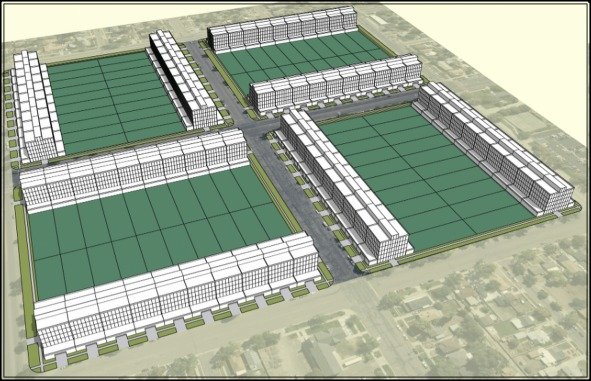
That participant-servant is the captain of 10. Each residential floor of an apartment building forms one unit around one captain’s participants — usually seven to twelve, centering on ten, which gives the office its name. Each building has four residential floors above the commercial first floor, so it has four captains, one anchored in each segmented identity: (A) partnered men, (B) partnered women, (C) single women, (D) single men. Together the four captains form the branch presidency, a presidency of four serving the building’s roughly ninety-six permanent residents.
Entry proceeds through governed tiers: a sponsored short visit requires only enough proof to identify the visitor and confirm the sponsor; a longer guest stay requires fuller proof and uses a rentable private suite, but still conveys no property and creates no membership; an applicant seeking an enterprise provides the fullest pre-agreement proof through qualification testing, a preliminary Life Plan, and a business plan. Only the final tier is irreversible: the participant conveys all property into community title by the Deed “which cannot be broken.” Everything before that step is reversible and conveys nothing.
Qualification, the Random Draw, and Succession
When an office seat opens, the CHOSEN document provides a four-step blueprint. First, the body states what the office requires. Second, it identifies people who meet those requirements. Third, it narrows that qualified group to two finalists. Fourth, it performs a random witnessed draw, so the final choice is not controlled by preference, faction, or campaigning.
Qualification is a filter, not a race. From a qualified group of about ten, the serving presidents narrow first to four, then to two, using published qualifications only — not popularity, organized support, or personal claims to the seat. The casting of the lot is the center of the CHOSEN document: after two qualified finalists remain, the departing president performs a witnessed random draw. The draw does not replace qualification; it comes only after candidates have already been tested and narrowed. Its purpose is to keep the final decision out of anyone’s control — it prevents king-making, protects the dignity of the person not chosen, and keeps the office from becoming a prize won by influence.
The final step is confirmation by the people served: every replacement must be sustained by secret ballot from more than 50% of the Enterprise Owners and dependents over eighteen whom that president serves, completed through a secure mobile application within one week, so the new president can take office on the departing president’s birthday. A captain of 10 is confirmed by the unit; a village presidency by its village; a district presidency by its district; bureau presidencies, because they serve the whole community, by all adults.
Age, Term and Replacement
The service age range is thirty to seventy-two. Thirty comes from the book of Numbers, where full Levitical service begins at that age — the same age also appears in the public lives of Joseph of Egypt, King David, and Jesus of Nazareth. Seventy-two comes from the source Joseph Smith Papers record where three disciples ask to remain on earth until that age; in this reading, seventy-two marks both the upper limit of public service and the birthday on which release occurs. The United Nations’ World Population Prospects 2024 places global life expectancy at birth near seventy-three years — used only for comparison, showing a seventy-two-year ceiling is not outside ordinary human experience. The ceiling is a constitutional service boundary, not a medical claim; it applies only to unpaid public offices.
The four-year term is a careful reconstruction from the pattern the documents give — the ministries of John the Baptist and Jesus of Nazareth provide the closest model of limited public service rather than life tenure. Political-science research on term length supports this as a matter of institutional prudence, not as proof from the texts.
The renewal rule is the clearest point where ROTATE and the early civic examples line up. A presidency of four does not start and end all at once: at the beginning, the four seats are assigned by lot to four yearly classes, so one seat opens in each of the first four years. After that setup, every seat serves a full four-year term, and the senior seat is released each year on that president’s birthday. Three experienced presidents remain while one new president enters — continuity without entrenchment, and because birthdays fall throughout the year, there is no election season for organized pressure to capture.
The 13-Week Calendar
A rotating office needs a clear calendar. The year is divided into four quarters, and each quarter lasts thirteen weeks. The first twelve weeks are normal operating weeks; the thirteenth is reserved for conferences, reviews, certifications, audits, and restoration work involving the whole community. The ordinary workweek runs Monday through Thursday — Friday, Saturday, and Sunday are protected from ordinary work and meeting demands.

Meetings follow a fixed pattern: presidencies meet Mondays; Councils of 12 meet Thursdays; Segment presidencies of three meet every fourth Tuesday; bureau coordination councils meet every fourth Wednesday. In a twelve-week operating quarter, a presidency of four that meets weekly gives each member three turns to preside; a presidency of three that meets monthly gives each member one turn; a Council of 12 gives each member one turn per quarter. No one person controls the meeting process for long.
The Solar Year Alignment
The community follows the ISO week-year rule. In some years the ISO calendar has a Week 53 — when January 1 falls on a Thursday, or on a Wednesday in a Gregorian leap year. When that happens, Week 53 becomes a Leap Week, sitting outside the four quarters between one year’s fourth quarter and the next year’s first. This keeps the correction in one whole week rather than scattering extra days through the year. Years such as 2026, 2032, and 2037 include this Leap Week.
The four-day workweek does not mean essential services stop — health coverage, nursing, outside grazing, mining, drilling, and utilities use a separate contractor schedule: three eight-hour shifts every day, workers serving one week on and one week off, carrying fifty-six hours in the active week and none in the next, a typical load of twenty-eight hours a week across the cycle. To recap the core structure:
- 4 quarters per year;
- 13 weeks per quarter;
- 12 operational weeks;
- 1 conference/restoration week;
- 4-day work week;
- Friday, Saturday, and Sunday normally free from standard production schedules;
- Leap week inserted only during ISO week-53 years.
“A NewVistas year shall consist of four quarters of thirteen weeks each. Whenever the ISO week calendar contains a Week 53, that week shall be observed as a Leap Week outside the quarters and shall occur between the fourth quarter of one year and the first quarter of the next.”
Status, Dependency and Succession by Sale
A person declares status for themselves — the community does not assign or investigate it. When someone applies, and again each quarter through the Life Plan, the person states the status used for seating: partnered or single, female or male. Same-sex partnering is recognized, and the declaration can be updated when it changes; this declaration has one job, placing the person in one of the four Segment co-ordinate courts for advocacy and seating. If a serving president’s declaration changes, the president stays in the same seat until the normal birthday release — the seat belongs to the office, not to the person’s circumstances at the moment.
Each adult has one enterprise; some minors, starting around age sixteen, may also hold a smaller enterprise under the same rule. Partners each hold their own enterprise, so if one partner dies, leaves, or fails, the other’s business continues.
Succession Is Simple in Principle: an Enterprise Is Not Inherited. It Is Sold.
When a child becomes an adult, the child does not automatically receive a parent’s enterprise — the child may apply like anyone else, qualify by ability, and enter the community agreement. If a child or another person is going to take over a business, the normal sale process applies: the successor first works as a full-time sub-contractor, learns the business, proves capability over two quarters, then buys it at a value the two owners negotiate, grounded in market analysis of the business’s probable future net. The same rule applies when an owner dies — the business may be sold to a qualified successor, but is not inherited.
This protects two things at once: the community retains title to the underlying assets, so a sale does not convert community property into private wealth; and a proven successor can take over a functioning business, paying from the continuing business’s after-tax profit above the Owner’s Draw rather than from personal savings or a lump sum. Bureau 5 oversees the Life Plan, Owner’s Draw, seller credit, and continuity standards; Bureau 19 oversees the Business Enterprise Plan, sale transfer, buyer viability, and the purchase-annuity method.
Completing the Convergence
The documentary convergence is now complete. The same method that closed each building at eighty offices and the community at 1,920 seats — exact words, exact numbers, and exact dependencies read until they meet — also resolves the questions those seats raised. STAND fixes bounded office and, through ROOMS, ties each office to a physical room that cannot be merged or doubled. The captains of ten explain how a person enters at the smallest accountable scale. CHOSEN fixes succession through qualification, narrowing, the casting of lots, and confirmation by those served. ROTATE, together with the age-and-term sources, fixes the thirty-to-seventy-two service window, the four-year term, the stagger by lot, and the senior-seat release on a birthday. The 13-week calendar gives rotation a working rhythm. Finally, the membership lifecycle fixes status, dependency, and succession by sale rather than inheritance.
All ten convergent documents have now been used. Together they disclose one coherent sequence: offices are bounded; authority rotates; renewal happens continuously rather than all at once; time is patterned; membership is governed across the whole life cycle.

This book remains a foundation rather than an encyclopedia. The detailed constitutional papers, ready-made enterprise business plans, building and fuel-cell specifications, vendor network, and founder timeline remain at newvistas.com as the living companion to the printed argument. But the argument itself closes here, where the final three documents complete the constitution begun by the first seven.