Chapter 8: Timeless Principles
These are not system features; they are its underlying invariants. While the concepts covered in earlier chapters are the specific institutions NewVistas builds — the settlement rails, residual, the Life Plan, and the rest — the principles here are the grammar those institutions must always follow. They fall into four areas: how authority is held, how the economy is structured, how the person is protected, and how the whole pattern endures.
1. Distributed Bounded Authority
1. Govern, Don’t Operate
Most institutions combine two roles that should remain separate: making the rules for an activity, and carrying it out. When one body does both, it can shape the rules to protect its own operations. NewVistas prevents this through one firm rule: bureaus govern, Enterprise Owners operate. A health bureau does not open hospitals or hire doctors — it sets clinic standards, certifies providers, and checks results, leaving care delivery to competing enterprise-operated clinics. Rule-makers cannot become operators, so they cannot twist rules to protect their own enterprises; operators do not write the rules, so no single business can capture an entire domain.
2. Separated Rails
Power becomes most dangerous when convenience makes it easy to hide. An office that both approves and audits a loan can bury its own mistakes. NewVistas separates ownership, money, and oversight into distinct rails — origination, lease and custody, title and finance, accounting, and audit — and no single office may hold more than one. The rails operate in a fixed sequence: a plan clears origination, a lease activates, title and financing attach, accounting records each step, and audit reviews afterward only when triggered. The office that decides whether capital may flow never controls the capital itself.
3. Bounded Office
Every public office is intentionally bounded: it lasts only for a set time, is unpaid, rotates to others, and outranks no other office. Four settled rules hold this together — fixed terms (four years, released on one’s own birthday), unpaid service (so office can never become a profession), rotating presiding and record-keeping (no permanent chair, not even a fixed meeting room), and none superior (no presidency outranks another). Because seats open on staggered birthdays rather than one election day, no faction can seize many offices at once — even emergencies cannot suspend that rotation.
4. People Govern
AI is used extensively to identify gaps in plans, flag anomalies, and reconcile accounts — but NewVistas rejects any shift of authority from people to tools. AI may check plans for missing artifacts and flag rule deviations; only people may set policy, determine eligibility, grant exceptions, or certify truth. An AI explanation is not the rule; an AI summary is not the official record. The machine expands what people can see; it must never replace the person who answers for what is done.
5. Under the Law
NewVistas does not make civil law and always remains under the law of the country where it operates — legally, a nonprofit community corporation holding assets through a trust, its businesses ordinary limited-liability companies. It has no government power over anyone: police and public authorities can be present only by renting space, like any other tenant. The community cannot block a public road, but it can control a private doorway — and even an emergency does not change that, because no office in the system has emergency power over another.
2. An Enterprise Owner Economy
6. Title and Custody
The community retains ownership of the civilization’s underlying foundation — land, buildings, equipment, infrastructure, intellectual property — while participants lease the right to exercise custody and make productive use of those assets. The community owns, but does not operate; the Enterprise Owner operates, but does not own the underlying base. Custody is secure because it is protected by rules, not personal choice: as long as the Enterprise Owner follows the lease, custody cannot be taken away, and if they fail, ownership still does not move into private hands — custody simply passes to another Enterprise Owner.
7. Owner’s Draw, Then Residual
Every Enterprise Owner first receives what is necessary to support themselves and their dependents; every remaining residual is then kept — preserved as productive community capital, never absorbed as overhead or converted to private wealth. The settlement runs in strict sequence: first the Owner’s Draw, then obligations (prior-period losses, required charges, taxes), and last, residual swept to the storehouse, never spent, never redistributed. An Enterprise Owner running an excellent business does not build spendable personal wealth — they grow the community’s permanent capital while drawing only what their Life Plan defines.
8. Access, Not Hoards
NewVistas rests on a different premise than conventional banking: liquidity is access, not accumulation. An Enterprise Owner’s spending power comes from bounded, rule-governed draws on a credit line, not money sitting idle in an account. The system creates no deposits, holds no savings, issues no withdrawable balances — with nothing stored, there is no withdrawal cascade and no panic that someone else will arrive first. A draw clears only when four conditions are met: a valid Life Plan, an active lease, capacity under the borrowing base, and agreement compliance.
9. Sale, Not Inheritance
NewVistas prevents hereditary dynasties by replacing inheritance with governed sale and proven qualification. With the exception of limited personal memorabilia, nothing transfers by inheritance — an enterprise moves to the next generation only through a governed sale, never through birthright. A child may continue a parent’s business, but only by qualifying and buying it like any other applicant, through the same four-stage process: application, internship, trial run, solo proving period, paid over time from the successor’s future profit. Adulthood creates an opportunity to apply, not a claim to inherit.
3. The Dignity of the Person
10. Capability, Not Wealth
Most economies operate by a quiet rule: capital creates more capital. NewVistas rejects that inherited advantage at the doorway — admission and advancement do not depend on wealth, family guarantees, collateral, or prior ownership. The decisive question is not “what do you have,” but “what can you build.” The rent gate asks only whether a person can pay verified market rent; the participant gate is cleared through a Life Plan, a Business Enterprise Plan, verified demand, and underwriting viability — proof of productive capacity, not proof of prior ownership.
11. Built-In Privacy
NewVistas makes privacy structural, not a courtesy that can be withdrawn when pressure rises. Its walls, acoustics, ventilation, access controls, and separable rooms create a protected private domain where dignity does not depend on goodwill or crowding. Each person keeps a private chamber for sleeping, bathing, study, and withdrawal from involuntary exposure — unaffected by class, temporary status, illness, or guest status. The same standard governs information: entrants provide proof that a threshold is met, while the community receives only that attestation, never the underlying records.
12. Proof, Not Surveillance
Any community capable of verifying everything must also prove that it will not observe everything. NewVistas’ governing doctrine: total proof, limited visibility. Every governance action creates a tamper-resistant proof record, so the community can verify what happened later without granting open-ended access to the data behind it. Records are visible only to those with a constitutional reason to see them; audit occurs only when a defined trigger requires it. The system can prove that an authorized action occurred without exposing the whole person, the full record, or any unrelated data.
4. Built to Endure
13. Replicate Without Drift
Founding movements often thin out as they spread — each new chapter improvises, and within a few generations the original has faded almost beyond recognition. NewVistas is built to spread by another law: it expands by replicating the same constitutional organism — the same geometry, public-building matrix, bounded offices, and economic sequence — rather than letting every settlement invent a new institutional body. Title stays distinct from custody, residual is preserved, offices stay bounded, and time keeps its rhythm, community after community.
14. License, Not Rule
Without a license safeguard, any organization that creates the community pattern could too easily become its de facto ruler. The NewVistas Institute’s role is strictly limited to granting building licenses, providing organizational documents, and supplying the operating software — beyond those functions, it holds no authority. Even a mature community continues using the Institute’s software only through a perpetual, minimal license fee, collected automatically by the system, never through a council seat or a veto. If the Institute disappeared tomorrow, each community would continue operating through its own offices as before.
Governance: One Integrated System, Disclosed by the Documents
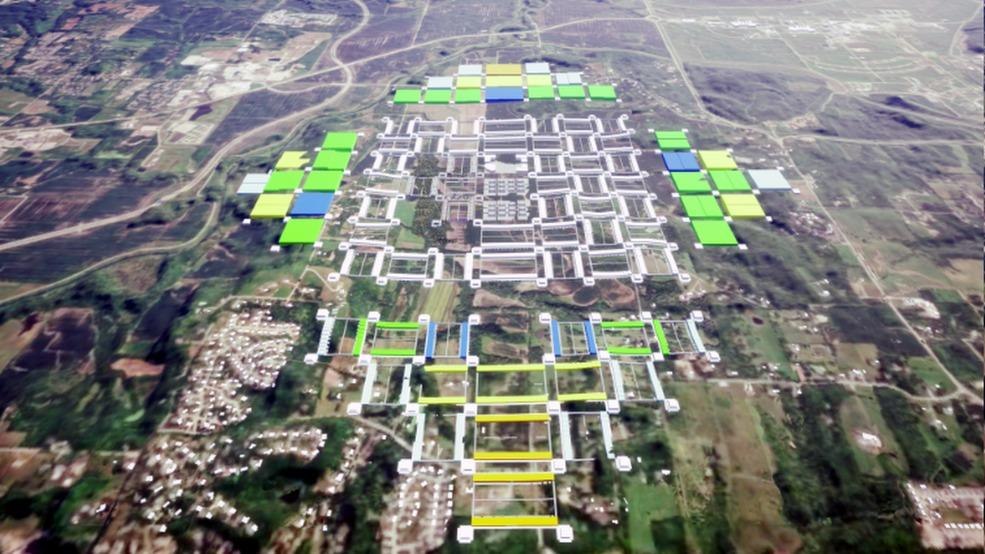
The NewVistas Constitution is not a single rulebook — it is an integrated system revealed by reading the founding documents together. One control principle runs through the whole: bureaus govern; Enterprise Owners and certified contractors carry out all real operations. The spatial plan is precise to the seat: a one-mile-square PLOT contains ninety-six villages and twenty-four public buildings in eight rows of three, with a 480-seat governing hall repeated four times in buildings 5 and 17, creating four courts of 1,920 seats total — matched exactly by 1,920 offices across the twenty-four buildings.
Because the seat field is highly divisible, governing bodies are built into the architecture rather than assigned later by committee. Three contiguous seats of one Segment form a presidency of three for Segment advocacy — 640 of them, across all four courts. Each numbered coordinate, repeated across the four courts, creates a four-person presidency with representation from every ABCD Segment. Ordered runs of these presidencies form 176 Councils of 12 — 96 Village councils, 24 District councils, 24 Data/Origination councils, 8 Department councils, and more — each a distinct domain, not a rung in a hierarchy. Every president belongs to at least one triad and one quad; none acts as an isolated authority.
| Body | Cadence | Day | Time |
|---|---|---|---|
| Segment presidencies (AAA, BBB, etc.) | Monthly | 4th Tuesday | 9–9:45 am |
| ABCD presidencies (Village, District, Data, Origination, Branch) | Weekly | Every Monday | 9–9:45 am |
| Councils of 12 (Village, District, Data/Origination) | Weekly | Every Thursday | 9–9:45 am |
| Bureau Councils 1–12 | Bi-weekly | 1st & 3rd Thursday | 9–9:45 am |
| Bureau Councils 13–24 | Bi-weekly | 2nd & 4th Thursday | 9–9:45 am |
“A government ordered by coordinates, offices, and councils, designed to prevent concentration of power through repeated peer witness and bounded place.”
The Environment: A Filled Earth, Not a Consumed One
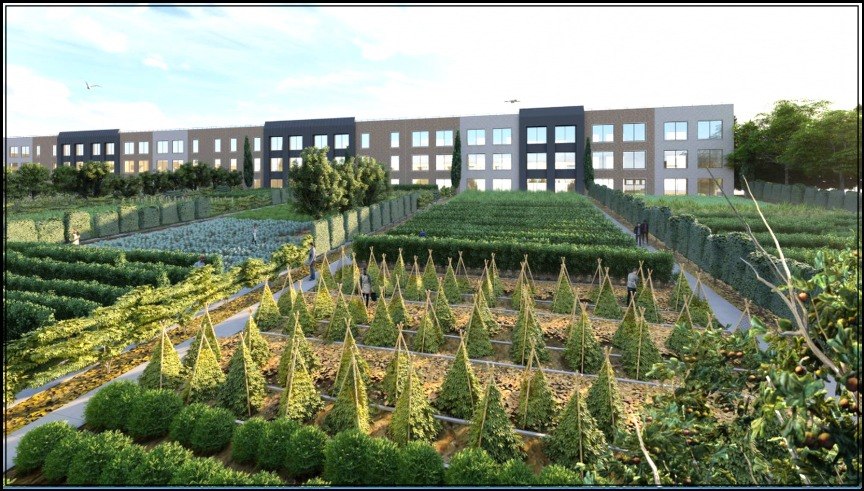
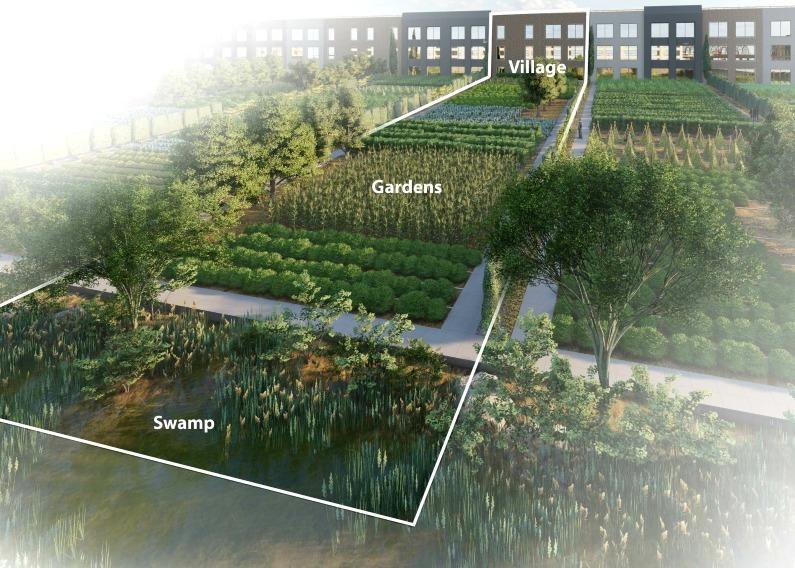
NewVistas rejects practices that fight the land: irrigating dry ground for rice, draining aquifers to keep grain alive through drought, or imposing grazing on landscapes that never evolved with large herbivores. Where a crop’s natural conditions are absent, the more responsible choice is to leave the land as wilderness. Properly sited, agriculture becomes restorative rather than extractive: dry farming builds soil carbon through disciplined rotation; wet farming works with existing flood cycles instead of resisting them; grazing, limited to grasslands shaped by megafauna, restores a broken biological loop as hooves open the soil and manure returns nutrients.
Biodiversity is treated as productive capital, preserved through cultivation rather than locked away in storage. NewVistas box-garden greenhouses and park-street systems function as living seed networks — rare herbs, heirloom cultivars, medicinal plants, and pollinator flowers remain viable because they are grown, used, and adapted, not sealed away in passive vaults. A food civilization that cultivates thousands of species is better equipped to withstand disease, climate volatility, and market disruption than one dependent on narrow genetics.
Footprint Accounting: True Land Cost Made Visible
The environmental rule succeeds because it uses economics instead of prohibition. High-impact goods are never outlawed; refined flour, added sugar and fat, alcohol, coffee, tea, and chocolate carry a confidential, per-individual footprint fee that reflects true land and resource cost, calibrated by Metrics Bureau 18 under Food/Health Bureau 4 standards. Whole and cracked grain, and genuine whole-grain bread, carry no such burden. The fee is not a tax and creates no taxing authority — it is a published price signal set through ordinary Business Enterprise pricing, not by decree.
| The rule is NOT | The rule IS |
|---|---|
| Prohibition — nothing on the list is banned | Priced to burden — an exponential, confidential, per-individual fee reflecting true land cost |
What matters is what was done to the grain, not what it’s called: cookies, cakes, pastries, and mass-produced white bread carry the fee; whole-grain bread does not. This makes the healthier, lower-footprint choice the easiest and cheapest one — diet architecture as open-terms economic accountability, not state prohibition. Bureau 18 measures and calibrates; it collects no funds and sets no personal penalties, and the individual calculation stays inside the participant’s own proof and accounting environment.
Bureaus govern; Enterprise Owners operate. Title is held in common; custody is earned and leased. Office is bounded; authority never accumulates. Proof is total; visibility stays limited. Fourteen principles, one grammar, the same in the first community and the thousandth — replicated intact, never reinvented, until the pattern the PLOT commanded to “fill up the world” has, in fact, filled it.